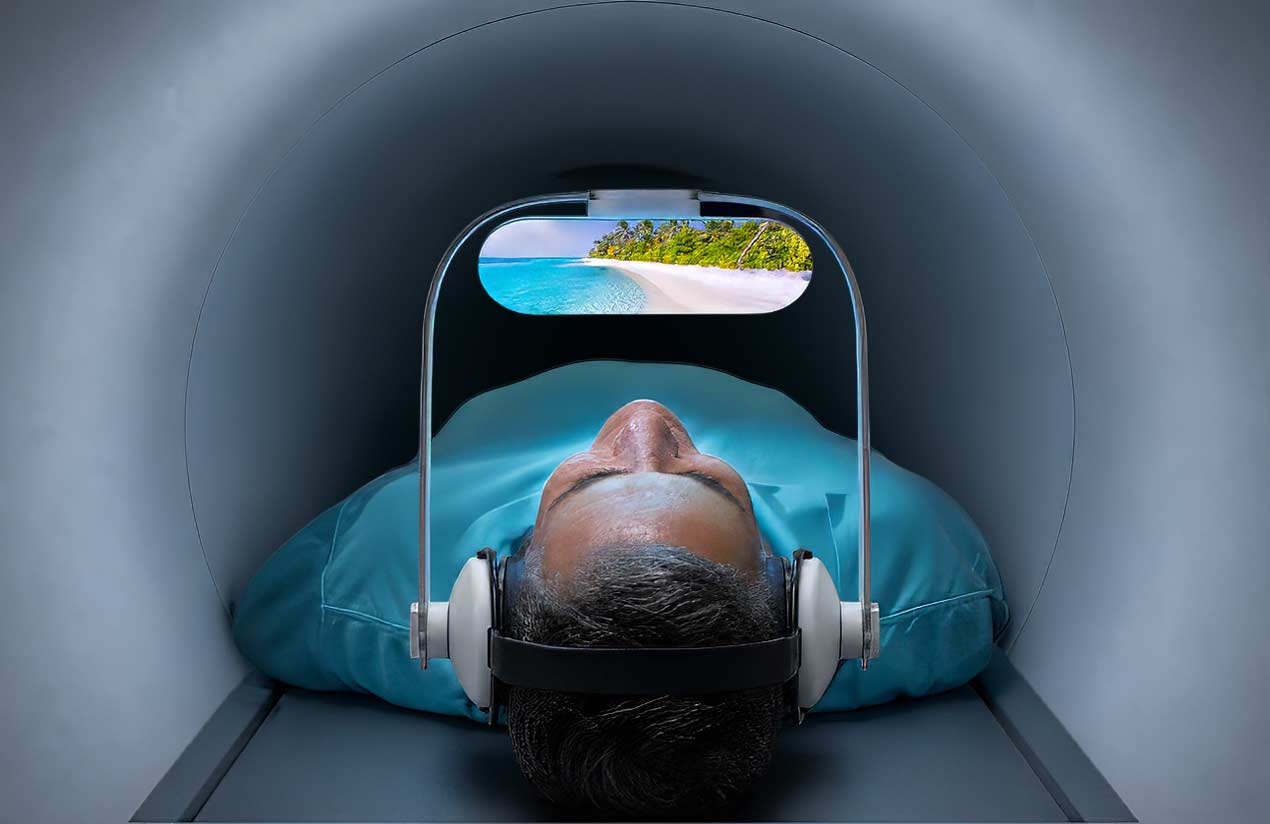
Why in-bore audiovisual matters
The hidden cost of a stressful scan
Anxiety, motion, and sedation quietly erode throughput and outcomes. The evidence for calming patients is hard to ignore.
1in3patients report anxiety before an MRI
$115Klost per scanner, every year, to patient motion
28.8ptsdrop in pediatric sedation with audiovisual distraction
MRIaudioWatch. Listen. Relax.
The problem: anxiety moves the patient, and motion costs the scan
Up to a third of patients report meaningful anxiety before an MRI, and a smaller group cannot complete the scan at all. Anxiety leads to motion, and motion is expensive. A widely cited analysis of clinical MR examinations found that patient motion was common enough to carry a real financial cost, estimating potential lost revenue on the order of $115,000 per scanner per year once repeated sequences and lost slots are accounted for (Andre et al., Journal of the American College of Radiology, 2015). Every motion-degraded sequence is time the magnet is not earning, a slot another patient could have used, and in some cases a callback that frustrates the patient and the referring physician. Reducing motion at the source, by keeping the patient calm, is one of the few levers that improves the image and the schedule at the same time.How in-bore video changes the experience
In-bore video places a display where the patient can see it during the scan, so instead of staring at the inside of the bore, the patient watches a movie, a show, or a calming nature scene. Combined with clear patient audio, the patient can hear the technologist and automated voice prompts, follow breath-hold instructions, and stay oriented throughout. The mechanism is simple. Attention is limited. When it is directed at a screen, there is less of it available for the enclosed space, the noise, and the passage of time. Patients report that the scan felt shorter and less stressful. Technologists report that patients hold still more reliably, which is the outcome that protects the image.A radiology manager’s experience
“A lot of patients who previously couldn’t go to this magnet are now capable of being in here.”For his technologists, who work under real time pressure, ease of use was essential, and patients, in his words, “love the video system.” As he puts it, he tells them, “Let’s send you on a vacation real quick,” and they enjoy their time in the scanner.
What the evidence says about sedation
The effect is clearest in pediatrics, where the alternative to a calm scan is often sedation or anesthesia. In a quality-improvement program at a pediatric hospital, scanning children awake with audiovisual distraction cut monthly minimal and moderate sedation use by an average of 28.8 percentage points, and every child triaged to audiovisual distraction completed a diagnostic MRI without sedation, with 96 percent of those studies finishing within the allotted exam time (Boriosi et al., Pediatric Radiology, 2025). Reviews of distraction strategies in pediatric imaging reach the same conclusion: giving the child something to watch and listen to reduces the need for sedation. Avoiding sedation is significant on its own terms. It removes a clinical risk, it removes the recovery time and staffing that sedation requires, and it opens scans to patients who would otherwise need to be scheduled around an anesthesiologist. For a pediatric or mixed-practice imaging center, a system that lets more children complete a scan awake pays for itself in schedule and in safety.Why “MRI-safe” is the part that matters
A screen inside an MRI suite is only useful if it is safe inside the magnetic field. Consumer displays, standard mounts, and ordinary cabling do not belong near a magnet. An MRI-safe or MR-conditional video system is engineered specifically for the environment: no ferromagnetic material near the bore, shielding that prevents the display from introducing artifact into the image, and components rated for the field strengths the suite runs. This is where the choice of system matters. The value of in-bore video comes from being able to use it on every patient, in every scan, without a safety question and without degrading the image the system is meant to protect. MRItv is designed for exactly that: a video system built for the bore, not a consumer screen adapted to it.What to look for in a system
If you are evaluating in-bore video for your suite, four things separate a clinical system from a workaround:- Safety documentation. Ask for the MR-conditional rating, the field strengths it is cleared for, and the compatibility with your scanner fleet. MRIaudio’s patient audio and video systems hold FDA 510(k) clearance and are MR-conditional, tested up to 3T.
- Image integrity. The system should be shown not to introduce artifact. A display that calms the patient but degrades the scan defeats the purpose.
- Clear patient audio. Video works best paired with clear audio, so the patient can hear the technologist and automated voice prompts and follow instructions throughout the scan. A combined audio and video system from one manufacturer removes the integration risk of stitching two vendors together.
- Retrofit and support. Most suites are not buying a new scanner to add video. Look for a system that installs on the scanner you already run, with support and parts behind it.
The bottom line
In-bore video is one of the few investments that improves the patient’s experience and the center’s numbers in the same motion. Calmer patients hold still. Stillness protects the image. Protected images mean fewer repeats, fewer callbacks, and in pediatrics, fewer sedations. The system pays for itself in reclaimed scanner time and in scans that would otherwise be lost. MRItv is MRIaudio’s in-bore video system, engineered for the MRI environment and built to pair with MRIaudio’s patient audio. Tell us the scanners you run, and we will confirm whether MRItv fits your fleet and what a retrofit looks like on the equipment you already own.Frequently asked questions
Does in-bore video reduce MRI anxiety?
Yes. Giving the patient a movie or calming scene to watch during the scan shifts attention away from the enclosed space and the noise, which patients report makes the scan feel shorter and less stressful.How does in-bore video reduce rescans?
A calmer patient moves less. Because patient motion is a leading cause of degraded images and repeated sequences, reducing anxiety reduces the motion that forces a rescan.Can in-bore video reduce the need for sedation in children?
Yes. In a pediatric-hospital quality-improvement program, audiovisual distraction reduced monthly sedation use by an average of 28.8 percentage points, and every child scanned with audiovisual distraction completed a diagnostic MRI awake (Boriosi et al., Pediatric Radiology, 2025). Giving a child something to watch and hear helps more children complete a scan without sedation.Is an in-bore video system safe inside the MRI?
A purpose-built MRI-safe or MR-conditional video system is engineered for the magnetic field, with no ferromagnetic material near the bore and shielding that prevents it from adding artifact to the image. Consumer displays are not safe in an MRI suite.Does in-bore video work with my existing scanner?
MRIaudio systems are designed to retrofit onto existing scanners across major OEM fleets. Request a quote to confirm compatibility with your specific system.References
- Andre JB, Bresnahan BW, Mossa-Basha M, et al. Toward Quantifying the Prevalence, Severity, and Cost Associated With Patient Motion During Clinical MR Examinations. Journal of the American College of Radiology. 2015;12(7):689–695. Link
- Boriosi J, Bryndzia C, Lasarev M, et al. A quality improvement project to reduce magnetic resonance imaging sedation in children. Pediatric Radiology. 2025;55:2148–2159. Link